
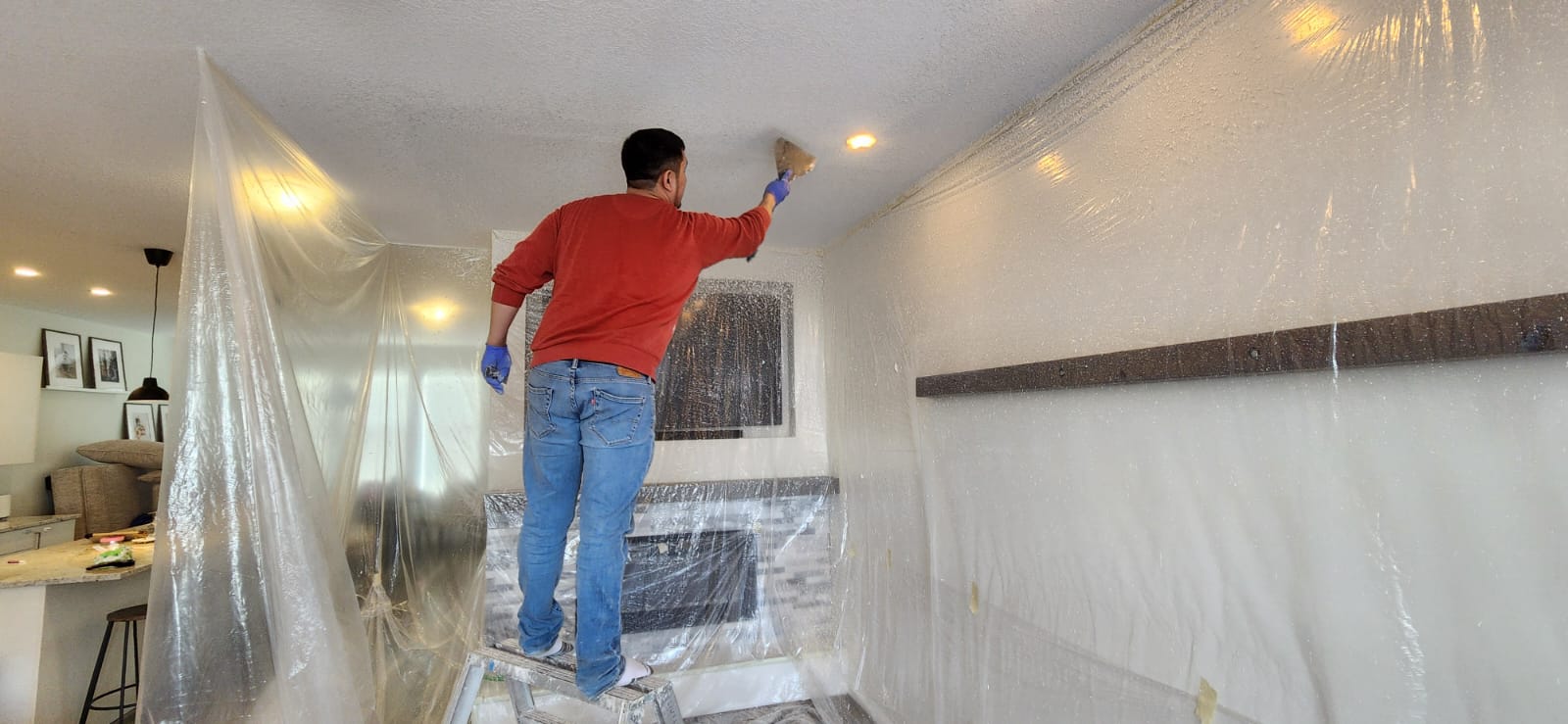
Matching starts before the texture step
The ceiling patch has to be rebuilt flat before the knockdown pattern is sprayed. If the base is low, high, or rounded, the final texture match will still read wrong even when the islands look similar.
This is one of the biggest misunderstandings homeowners have about ceiling texture repair. They look at the visible finish and assume the match is all about the pattern. In reality, the pattern is only the last part of the job. If the drywall rebuild, seam correction, or patch edge is wrong, the eye will still catch the repair later, even if the texture itself looks close.
A good match starts with a patch that sits at the right height, has the right shape, and blends cleanly into the surrounding field. Only then does the texture step have a real chance of disappearing after paint.
Pattern timing matters
Existing knockdown ceilings vary in build and timing. A heavy ceiling needs a different spray and knife-down rhythm than a lighter pattern. That is why texture matching belongs beside proper ceiling prep, not as a quick cosmetic add-on.
Matching is not only about what goes onto the ceiling. It is also about when the ceiling is touched after application. Knockdown texture is shaped by timing. If the material is flattened too early, the pattern can collapse. If it is flattened too late, the islands may stay too sharp or heavy. That timing changes from one ceiling to another depending on build, room conditions, and the texture already on the surface.
This is why very small spot repairs can still be difficult. The contractor is not reproducing a generic look. They are trying to make one part of the ceiling behave like the rest of the room.
Texture thickness matters as much as the pattern
Homeowners often describe a mismatch by saying the patch “doesn’t look the same.” Usually that means one of three things: the repair sits too flat, the repair sits too heavy, or the patch edge catches the light differently from the original ceiling. Those are thickness and transition problems just as much as pattern problems.
A patch with the right general texture but the wrong build will still stand out. That is why experienced matching work usually includes test adjustments and careful edge feathering rather than treating the job like a one-pass repair.
Paint sheen can expose a poor match
Sometimes the texture is close enough, but the repair still flashes because the paint sheen around the patch is different. This is especially common when a ceiling has aged paint, partial repaint history, or stain blocking only in the patch area. Under side light, the eye notices the sheen change even before it notices the texture pattern.
This is why matching work often needs to be discussed together with primer and paint, not treated as a completely separate cosmetic step. A repair that is technically textured well can still read poorly if the finish coat around it is inconsistent.
Water damage and pot-light changes complicate matching
Matching gets harder when the patch came from a leak or a fixture change. Water damage can weaken a wider area than the stain suggests. Pot-light work can create several repair points across the same ceiling plane. In both cases, the contractor may need to blend a broader section than the homeowner expected.
If your project started with one of those problems, it helps to review knockdown ceiling water-damage repair and pot-light patch matching. Those pages explain why matching often expands beyond a simple spot repair.
When the repair becomes a wider texturing job
Some ceilings start as a patch match and then expand into a broader finish decision because the surrounding ceiling is too inconsistent, too damaged, or being updated after popcorn removal. When that happens, the commercial next step is knockdown ceiling finish. If the scope stays localized, the better local action page is Calgary ceiling texture repair.
This usually happens when the contractor discovers that the repair is only one visible part of a broader issue. Maybe the surrounding texture was already inconsistent. Maybe there are multiple old patches. Maybe the room is mid-renovation and the homeowner now wants the whole ceiling brought together under one finish. At that point, “matching” becomes less useful than treating the room as a new finish project.
What a good match should look like from the floor
Homeowners do not inspect ceilings from six inches away with a work light. They live with them from normal viewing height. A good match should disappear from the floor in normal room lighting and still hold up under the kind of daylight the room gets every day.
That means the repair should not form a visible outline, should not look flatter or heavier than the surrounding ceiling, and should not create a change in sheen that immediately draws the eye. Perfect invisibility in every light is not always realistic, but the repair should not announce itself.
Common signs of a poor texture match
The most common warning signs are patch edges you can see after paint, a repair that feels smoother than the rest of the ceiling, a repair that looks too chunky and heavy, or a bright halo around the repaired area. Another common problem is a patch that only looks acceptable from one angle but flashes clearly when you move through the room.
These are the issues homeowners often notice after the job is supposedly complete. They are also the signs that the contractor treated matching as a quick add-on instead of as finish work that requires judgment.
Questions worth asking before you book
If you are hiring someone for knockdown ceiling matching, ask how they handle base rebuilding, whether they test pattern and thickness before the full patch is finished, how they approach edge feathering, and whether paint blending is part of the discussion. Those answers will tell you far more than a generic promise to “match the texture.”
It also helps to send wide room photos, not only close-ups. The ceiling has to be judged as part of the room, because lighting and sightlines make a major difference in whether a repair really disappears.
Small patches are not always easier
Homeowners often think a very small repair should be simple to match because the damaged area is tiny. In reality, small patches can be some of the hardest to hide. They sit inside a larger uninterrupted field, and the surrounding ceiling gives the eye a direct comparison. If the pattern, thickness, or sheen is even a bit off, the patch can stand out sharply.
That is why a contractor may spend more time testing and blending a small visible repair than homeowners expect. The size of the patch does not always predict the difficulty of the match.
When repainting the whole ceiling makes sense
Sometimes the texture match itself is close enough, but the age of the existing paint makes the repair hard to hide. In those cases, a full ceiling repaint can be the cleaner answer. It does not replace good matching work, but it can help unify the final look when spot painting would leave a visible difference.
This is especially common in brighter rooms and on ceilings that have been repainted in sections over time. A homeowner should think about the repair as both a texture job and a finish job, not just one or the other.
The right next step depends on scope
If the problem is truly isolated, the local repair page is usually the best place to start. If the repair is one part of a bigger upgrade, the full knockdown ceiling page is the better next move. The important part is not forcing a small-match mindset onto a ceiling that is really asking for a broader reset.
Matching works best when the scope is judged honestly. Once that happens, the repair plan usually becomes much clearer and the homeowner knows whether they are fixing one area or rethinking the whole ceiling.
What homeowners should look for
Check whether the repair edge is visible, whether the paint sheen flashes around it, and whether the texture sits flatter or heavier than the surrounding field. Those are the signs that the match was not handled well.
If you already know your ceiling needs more than a spot fix, the better next step is to look at the full finish page or the local repair page, depending on how broad the project has become. Matching is valuable, but only when it still makes sense for the ceiling you actually have.
The clearer the scope is at the start, the more likely the finished repair will actually disappear the way homeowners want it to.
That is ultimately what good matching is about: a repair that stops calling attention to itself and lets the room feel normal again.