
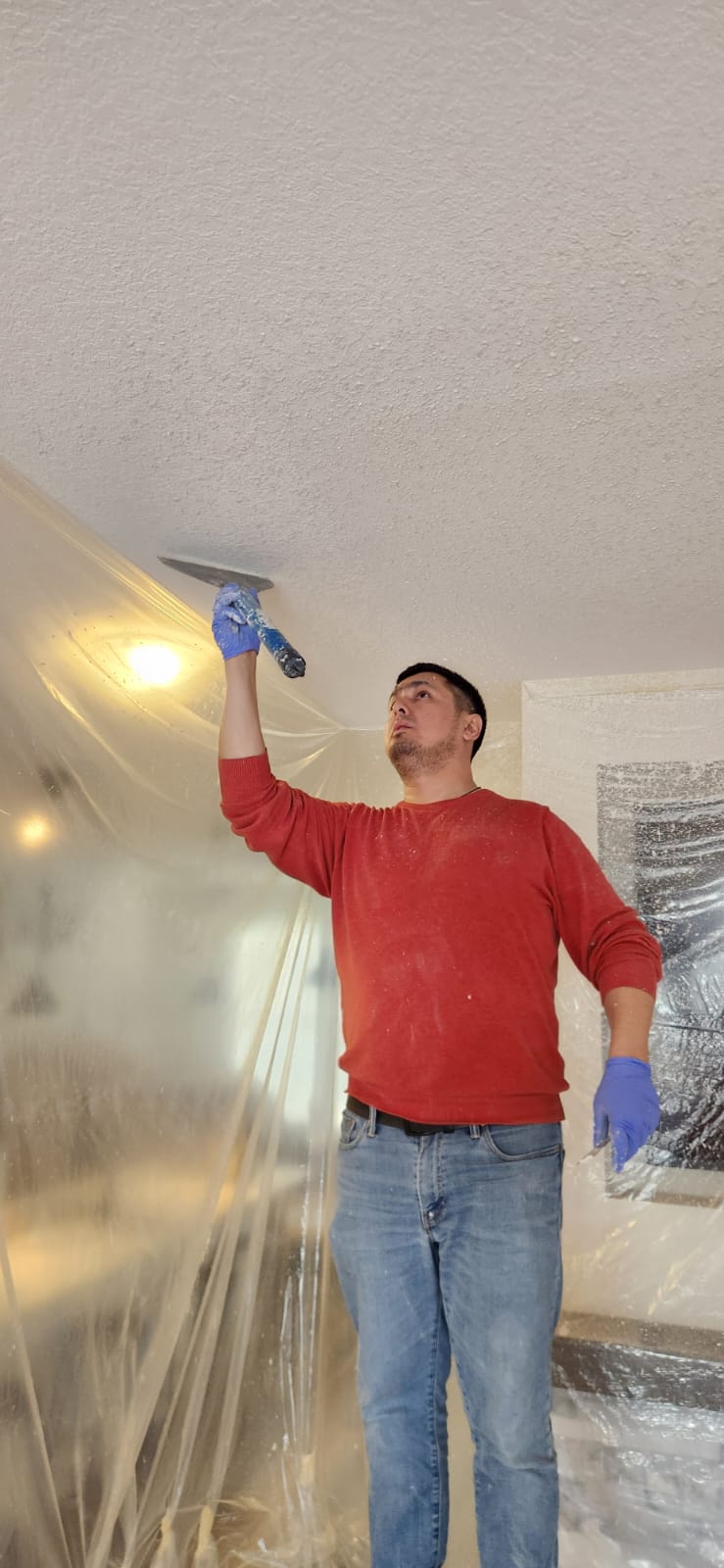
What counts as a ceiling imperfection?
Old tape lines, cut-out patches, leak stains, ridge marks, poor sanding, and low spots all count. These problems usually become more obvious after paint, especially under side light.
Homeowners often assume a ceiling imperfection has to be severe before it matters. In practice, the most frustrating imperfections are often the smaller ones spread across the ceiling. A little ridge here, a patch halo there, a slightly rough repair near a light, a shallow low spot by a seam. Individually they may not seem serious. Together they can make the finished ceiling feel uneven and unfinished.
That is why prep work is so important before texturing. The final finish may soften some small variation, but it will not erase a ceiling that is already fighting against obvious surface problems.
Why prep matters before texturing
Homeowners sometimes hope a new finish will hide everything. In reality, a bad base usually needs more repair, flatter prep, or broader resurfacing before the final texture goes on. The support articles that explain that are how to match existing knockdown ceiling texture and when to skim coat before knockdown texture.
Prep is what lets the texture behave like a finish instead of like camouflage. If the contractor is trying to make texture cover up ridge lines, patch edges, or old damage, the result will usually feel compromised from the start. The homeowner may still see the problem, just in a different form.
Good prep does not always mean a massive rebuild. Sometimes it means better sanding, a cleaner patch, or a wider feather at the repair edge. Sometimes it means a skim coat. The point is that the ceiling has to be honest enough for the finish to sit well on top of it.
Imperfections show more after paint than before
One reason homeowners are surprised by ceiling flaws is that they become more visible after the final paint goes on. Fresh paint can unify color, but it can also make surface variation easier to see, especially when light moves across the ceiling from a window or a row of fixtures.
This is why “it looked fine before paint” is not a good enough standard. A ceiling should be prepared with the finished room in mind, not judged only in the middle of the work.
Common problem: patch edges that were never flattened properly
Patch work often fails visually because the repair edge was left too abrupt. Even if the center of the patch is sound, a visible transition around it can catch light and create a ring or halo effect. Once new texture sits on top of that, the problem may still show.
This is one reason homeowners should be cautious about fast patching promises. A repair is not really ready for texture until the transition into the surrounding ceiling is controlled.
Old tape lines and seams often need more attention than expected
Ceiling seams can become visible over time because of movement, old repairs, poor original finishing, or moisture history. If those lines are already visible before the new texture goes on, they should not simply be ignored. Depending on severity, they may need targeted correction or broader resurfacing.
This is especially true in rooms with long sightlines. A ceiling seam that runs across a bright room will usually matter more than the same issue in a smaller, darker space.
Water marks and stains are not only cosmetic
A stain can look like a paint issue when the real problem is a weakened patch of drywall, failed tape, or old leak history. If that area is not corrected properly, the ceiling can still look wrong after texturing and the stain can even return through the finish later.
If the imperfection began with water, it helps to look at knockdown ceiling water-damage repair so you understand why some repairs become wider than expected.
Fixture changes create their own kind of ceiling imperfection
Pot lights, fixture relocations, and electrical changes leave more than holes. They leave a ceiling that has to be rebuilt flat, blended into the surrounding finish, and often repainted more broadly than homeowners first expect. These are some of the most common imperfections that still show after “quick” repair work.
If your ceiling has that type of history, the next guide to review is pot-light patch matching in Calgary.
When skim coating becomes the smarter answer
Sometimes the ceiling has too many imperfections scattered across too much of the field for spot repairs to be the right answer. That is when a skim coat starts to make sense. It gives the room a broader reset instead of asking the finish to sit on top of a collection of old problems.
This does not mean every rough ceiling needs a full skim coat. It means homeowners should be open to the idea when the contractor is trying to solve a real surface problem rather than just adding labour for the sake of it.
When the project becomes a texturing job
Once the ceiling is corrected, the commercial finish page is our knockdown ceiling texturing service. That is where the finish choice, cost factors, and conversion path are handled.
In other words, prep work should guide the project into the right next step. If the ceiling is now stable and ready, the homeowner can move forward with the finish decision confidently. If the base still is not right, it is better to keep solving the prep problem than to rush into texture.
A homeowner checklist before texturing starts
Before the finish stage begins, it helps to ask a few simple questions. Are the old patch edges still visible? Do any seams still catch the light? Are there stains that still need sealing? Is the room bright enough that even small issues will show later? Has the contractor explained whether the ceiling needs only spot correction or something broader?
Those questions keep the project grounded in the real condition of the room, not just in the hope that the texture itself will fix everything.
The finished ceiling should feel calm, not busy
The best ceiling finishes are often the ones homeowners stop noticing because the room simply feels more complete. That only happens when the imperfections underneath were handled seriously enough before the final finish went on. A ceiling that still shows old problems through the new texture rarely feels complete, no matter how fresh the paint is.
That is why fixing imperfections first is not an optional detail. It is part of what makes the finished room feel properly renovated instead of partially disguised.
Once homeowners understand that, quote conversations make a lot more sense. Prep stops feeling like a vague add-on and starts feeling like the stage that protects the quality of the finished room.
The smart next step depends on what the ceiling shows
If the imperfections are mostly local, the next move may be Calgary ceiling texture repair. If the room is being modernized more broadly, the better next step may be knockdown ceiling texture. Either way, the prep work should guide the finish choice, not be ignored by it.
That is the clearest way to think about ceiling prep: let the ceiling condition decide what kind of project you actually have. Once you do that, the finish choice, quote, and next step become much easier to understand.
Why this topic matters before you spend money on the finish
A new finish is often the visible part of the job, but prep is what protects the value of the project. If the old imperfections are still in control, the new ceiling can end up looking only partly improved. That is why homeowners are usually better off solving the base honestly first and then choosing the finish from a stronger position.
Once that happens, the finish has a real chance to look calm, consistent, and worth the investment.
That is the difference between a ceiling that only looks newly painted and a ceiling that actually looks properly finished.
What a well-prepped ceiling usually feels like
Homeowners do not usually walk into a room and think about feather edges, patch transitions, or skim work. They think the ceiling looks calm, even, and finished. That reaction is usually the result of better prep. The ceiling does not keep drawing attention to older damage, awkward repairs, or light-catching defects.
That is the practical standard worth using. If the prep work helps the room feel settled and complete, it is doing its job. If the old imperfections still control what the homeowner sees after the finish is done, the prep was not strong enough.
Why prep quality affects confidence in the whole project
Ceiling work often shapes how homeowners feel about the renovation overall. A clean finished ceiling makes the room feel cared for. A ceiling with lingering flaws can make even new paint and lighting feel less convincing. That is why prep quality has more value than people expect before the work starts.
Once the surface issues are handled honestly, the finish stage becomes much simpler and the result is much easier to trust.