
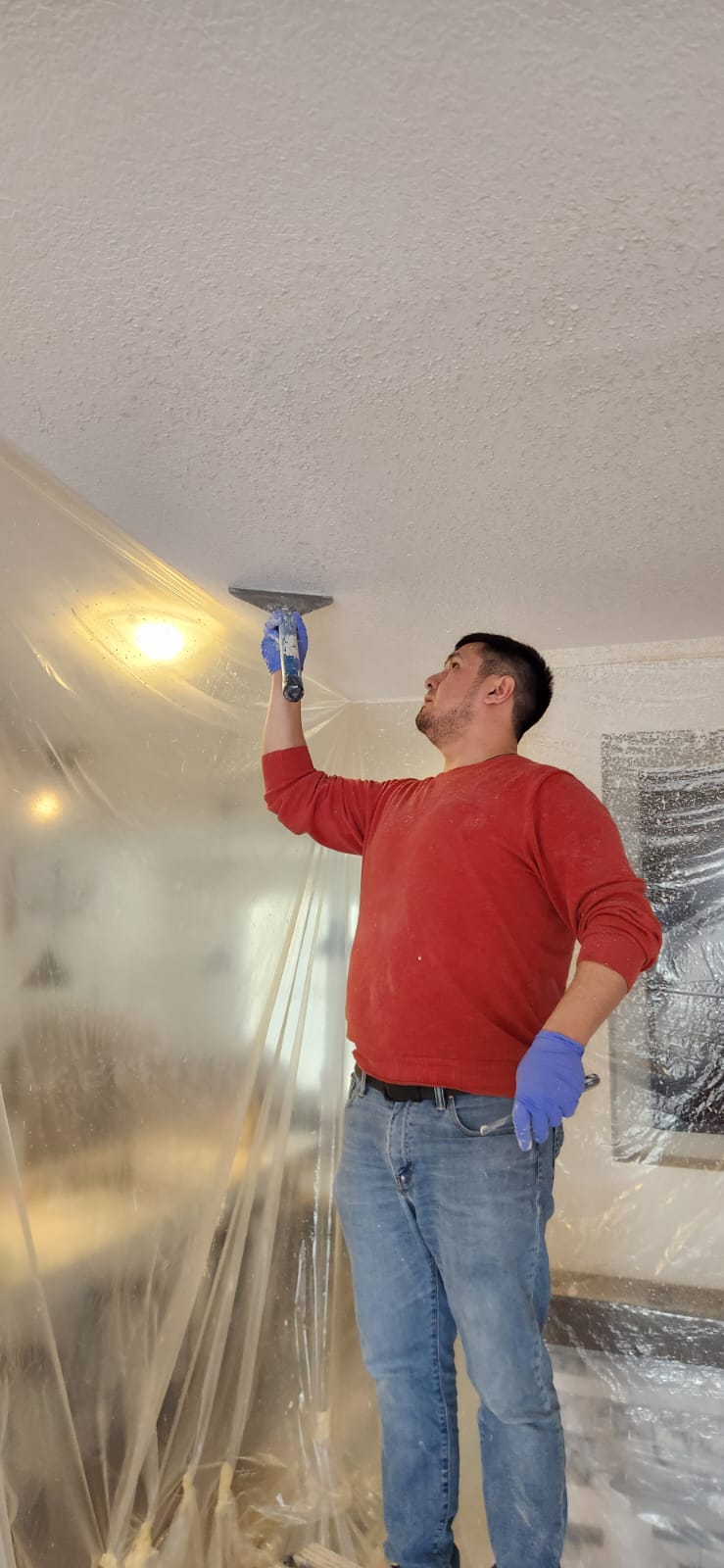
Skim coating is not automatic, but it is often necessary
Not every ceiling needs a full skim coat. But after popcorn removal, heavy patching, or broad unevenness, texture alone will not create a clean final result.
This is one of the most important prep decisions in a knockdown project. Homeowners often hope the texture itself will hide whatever the ceiling looks like after removal or repairs. Sometimes that is partly true. But when the ceiling has broad ridges, low areas, rough seams, or several visible transitions, new texture alone is usually not enough.
A skim coat is not just “extra mud.” It is a way of bringing the surface back under control so the finish has a better base. Without that step, the finished ceiling may still look uneven, patchy, or rushed once the room is painted and lit.
What skim coating fixes
It reduces ridges, fills low areas, and creates a more even plane before the new finish is applied. That is why prep quality often decides whether a knockdown ceiling looks clean or rushed once it is painted.
Homeowners usually notice skim coating through the result rather than the process. The ceiling feels calmer, flatter, and more unified. The texture sits more evenly. Patch areas stop telegraphing through. Light moves across the room without catching so many old problem spots. Those are the practical reasons skim coating matters.
It also helps create a more predictable base for the contractor. When the ceiling is closer to one even plane, the final finish can be applied more consistently. That is a major advantage in larger rooms and brighter spaces.
How this leads back to the money page
Once the ceiling is ready, the main commercial destination is knockdown ceiling texture. The skim coat page owns the prep intent, while the knockdown page owns the finish intent.
In other words, skim coating is not the end goal for most homeowners. It is the stage that helps the final knockdown finish look like it should. If you only think about texture and ignore the base, you are much more likely to be disappointed with the finished room.
Common signs a ceiling may need skim coating
A ceiling often needs skim coating when you can already see broad unevenness before the new finish goes on. Old tape lines, wide patch transitions, shallow low areas, rough scraped zones after popcorn removal, and several previous repairs are all common warning signs. These problems are easier to notice under side light or in rooms with a lot of natural daylight.
If you can see the ceiling’s history clearly before the finish is applied, chances are the contractor is looking at skim coating for a reason. It is usually an attempt to fix the issue properly, not a random add-on.
After popcorn removal, skim coating becomes more common
Popcorn removal is one of the situations where skim coating comes up most often. Once the old finish is off, the ceiling may reveal damage, roughness, or uneven areas that were not visible before. Some ceilings come through removal in decent shape. Others clearly need more correction.
That is why homeowners planning a popcorn-to-knockdown upgrade should not assume the quote can be finalized around removal alone. The prep stage in the middle matters just as much. If you are in that situation, read popcorn to knockdown ceiling conversion in Calgary.
Heavy patching can force the decision
A few small repairs do not always require a full skim coat. But when the ceiling has several patches or wider rebuild work, the contractor may need to skim more broadly so the ceiling reads as one surface instead of a collection of separate repairs. This is especially true in open rooms where the eye takes in the entire field at once.
When that happens, the choice is not really between “skim coat” and “no skim coat.” The real choice is between paying for the correction work now or paying for a finish that still looks visually inconsistent later.
When a full skim coat may not be necessary
Some ceilings only need localized repairs and better sanding, not a full skim across the whole field. If the base is generally sound, the texture is not fighting against large visible flaws, and the room does not reveal every ceiling issue under strong light, a more limited prep path may be enough.
That is why this decision should be based on the actual ceiling, not treated as a fixed rule. Homeowners get the best outcome when the prep plan matches what the room really needs.
Skim coating changes cost and timeline, but often improves value
Yes, skim coating adds labour and can lengthen the project. But the more useful question is whether it improves the value of the result. If the ceiling would otherwise look wavy, patched, or unfinished after the texture goes on, skim coating is often money well spent.
If you want to understand how that affects price, the next helpful guide is knockdown ceiling cost in Calgary. That page explains why prep work often moves the quote more than the texture step itself.
Questions to ask when skim coating is recommended
Ask what specific issue the contractor is trying to correct. Is it broad unevenness? Several patch transitions? Rough popcorn removal damage? Light-revealed seams? A clear answer usually means the recommendation is based on the actual ceiling rather than a generic upsell.
It also helps to ask whether the skim coat is localized or broad, whether the room will be left finish-ready, and how the contractor expects that step to improve the final ceiling. When the reasoning is clear, the extra labour makes more sense.
The final decision should be about the finished room
Homeowners rarely care about skim coating for its own sake. They care about whether the ceiling will look clean after the renovation is done. That is the standard to use. If skim coating helps the room feel more finished and prevents the new texture from sitting on top of obvious problems, it is probably the right move.
Once the ceiling is ready, the next step is simple: move into the finish stage with a cleaner base and a much better chance of ending up with a ceiling that looks right.
If the room already has broad defects and you skip that decision now, the ceiling may keep reminding you about it later. That is why homeowners are usually better off understanding the prep honestly before they commit to the finish.
A good quote should explain the reason
One of the best signs in a quote conversation is when the contractor can clearly explain why skim coating is being recommended. If the answer is tied to visible conditions in the room, that is useful. If the answer is vague, it is worth asking more questions. Homeowners should understand what problem is being solved before they agree to extra prep.
Clear reasoning usually leads to better decisions, better expectations, and fewer surprises once the project gets underway.
That clarity also makes it easier to compare quotes. Two contractors may both mention knockdown texture, but only one may be accounting for the prep actually needed to make the finish look right.
Why skipping skim coating can cost more later
Homeowners sometimes save money up front by declining broader prep, then end up frustrated because the finish still shows the old issues they hoped the new texture would hide. At that point, correcting the ceiling later can be more expensive than addressing it properly during the original project.
That does not mean every quote should include skim coating. It means homeowners should understand the risk of skipping it when the room already shows clear signs that the base is not ready.
A practical rule for decision-making
If the imperfections are broad, repeated, and easy to notice from the floor, skim coating should be taken seriously. If the issues are limited, isolated, and do not affect the overall field, a more targeted prep path may be enough. The point is to make the decision based on how the whole ceiling will look, not on how one small area behaves by itself.
That usually leads to a better-looking finished room and fewer regrets about trying to save the wrong step.
In most cases, homeowners feel better about the cost once they understand exactly what problem that prep step is solving.
What homeowners usually regret more: paying for it or skipping it
Most regret comes from skipping necessary prep, not from approving it. When homeowners pass on skim coating even though the ceiling is broadly uneven, they often end up staring at the same issues after the new finish and paint are done. The ceiling may be improved, but it still does not feel fully corrected.
When skim coating is genuinely needed, it usually protects the quality of the whole project. That is why a well-explained prep recommendation is often worth taking seriously instead of treating it as an optional add-on.
The simplest way to think about the decision
If the ceiling is close enough to flat that the finish can sit evenly, skim coating may not be necessary. If the surface still looks unsettled from the floor, that is the strongest sign the ceiling needs more work before texture. Homeowners do not need to become drywall experts to make the decision. They only need a clear explanation of what the room will look like with and without that prep step.