
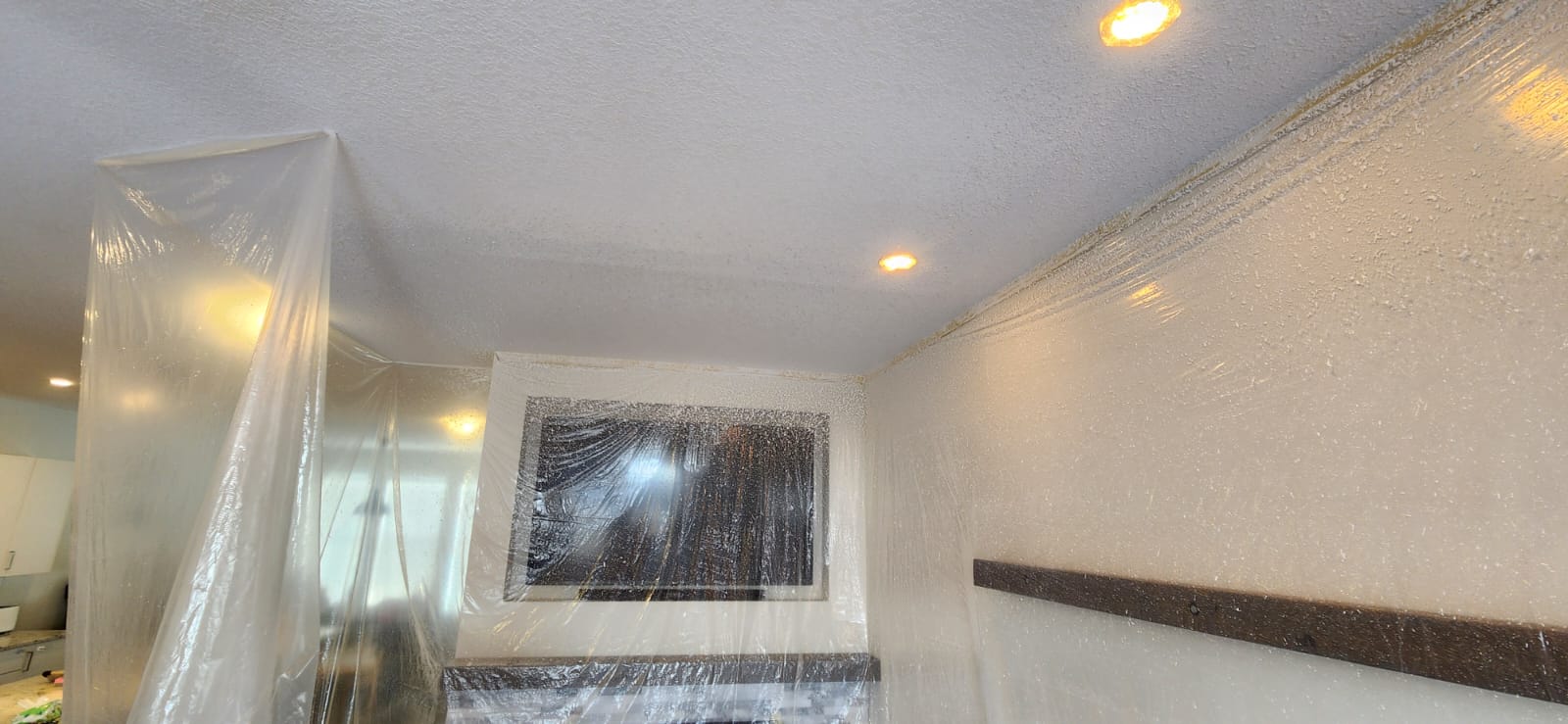
The project starts with removal, not with texture
A popcorn-to-knockdown conversion begins with removal. Until the old finish is removed, it is impossible to know whether the ceiling underneath only needs spot repair or broader resurfacing.
This is the first place homeowners usually underestimate the job. They imagine scraping one finish off and replacing it with another, as if the old ceiling is just a surface layer with nothing going on underneath. In reality, the removal stage often tells you what kind of project you actually have. It reveals how clean the base is, whether there are old repairs, whether there is damage from leaks or fixture changes, and whether the room will need more correction than expected.
That is why the best conversion projects are planned as one complete process rather than several separate tasks. Removal is not just the first step. It is the step that determines the rest of the scope.
The middle stage is where most of the quality is won
Once the popcorn is down, the ceiling may need seam work, patch blending, stain blocking, or a broader skim coat. That prep controls how good the final knockdown finish can look.
Homeowners usually focus on the before-and-after visual change, but the middle stage is where the contractor earns the result. If the ceiling is not corrected after removal, the new finish can still telegraph the old problems. Seams may remain visible, patches may flash, and uneven areas can still catch the light once the room is painted.
This is also why one conversion can look much better than another, even when both end with a knockdown finish. The finish itself does not do all the work. The prep beneath it decides whether the room looks clean, modern, and finished or just newly textured.
Why knockdown is a common upgrade path
Many homeowners want a modern ceiling without the unforgiving standard of a fully smooth finish. That is why the main action page after removal is knockdown ceiling texture Calgary.
Knockdown is a common upgrade path because it gives homeowners a practical middle ground. It feels more current than popcorn, more controlled than heavier textures, and more forgiving than a full smooth finish. In homes where the ceiling has some age, minor repair history, or natural variation, that balance makes knockdown a strong fit.
In many Calgary homes, the goal is not a perfectly flat architectural ceiling. The goal is a ceiling that no longer looks dated and no longer undermines the rest of the room. Knockdown often hits that mark better than homeowners expect.
Where skim coating fits
If removal exposes broad irregularity across the field, skim coating may be the right prep move before the new finish is applied. The prep article that supports that decision is when to skim coat before knockdown texture.
Skim coating matters when the popcorn removal stage leaves behind a ceiling that is too rough, too uneven, or too full of repair history for the new finish to sit well. It is not always needed, but when it is needed, it can be the difference between a professional result and a ceiling that still looks unsettled after the work is done.
Homeowners sometimes hesitate when skim coating is mentioned because it sounds like an added cost. In reality, it is often a quality decision. It gives the new finish a more even base and prevents the homeowner from paying for a ceiling that still feels rough or patchy after paint.
Why homeowners choose conversion instead of removal only
Some people initially plan to remove the popcorn and stop there. Once they see the ceiling underneath, they realize that “removal only” still leaves them with decisions about repairs, flatness, and what the final room should look like. That is why many projects naturally move toward a complete conversion instead of stopping at the scrape stage.
A full conversion also makes more sense when the room is being updated anyway. New paint, trim, floors, or lighting tend to make an unfinished or partially corrected ceiling stand out more. If the goal is to make the room feel complete, many homeowners would rather finish the ceiling properly once than live with a half-step result.
Common surprises after popcorn removal
The most common surprises are old patch repairs, visible tape lines, staining that was hidden by texture, ridges from previous work, and ceilings that look flatter in one area than another. None of these problems automatically ruin the project, but they do change the amount of prep required before the new finish should go on.
This is why contractors often talk about “seeing the true ceiling condition” after removal. It is not a vague phrase. It literally means the real base only becomes visible once the old finish is gone.
How the timeline usually moves
A clean popcorn-to-knockdown project usually flows through removal, prep assessment, repairs or skim work if needed, texture application, and then the finish-ready handoff. The exact timing depends on how much drying, patching, or paint prep is required between those steps.
Homeowners get better expectations when they understand that the project is staged. The ceiling may not go from old texture to final finish in one uninterrupted pass. Drying times and correction work are part of how the result stays clean.
How conversion cost is really built
The cost is rarely based on the new finish alone. It is built around what must happen between the old ceiling and the final result: removal, protection, repair work, skim coating if needed, texture application, and sometimes primer or paint. That is why conversion quotes can vary so much from one room to another.
If you want the detailed cost side of the conversation, the next read is knockdown ceiling cost in Calgary. That guide explains how room size, ceiling condition, and prep requirements shape the quote.
When a room is a good candidate for conversion
Conversion is a strong choice when the room still has dated popcorn texture, the homeowner wants a more current finished look, and the project is already important enough that half-measures would feel disappointing. Main-floor living spaces, updated basements, hallways, and full-home refreshes are common examples.
It also makes sense when the homeowner wants a finish that is cleaner than popcorn but does not want the stricter prep demands of a fully smooth ceiling. In those cases, knockdown often gives the best overall value.
Questions worth asking before you book
Ask what happens after the popcorn is removed if the ceiling is rougher than expected. Ask whether patching, skim work, stain blocking, and paint-ready completion are included in the discussion. Ask whether the quote is built around a true conversion or only around the first removal stage.
Clear answers help homeowners compare quotes fairly and avoid finding out too late that the “cheap” option only covered part of the real project.
Why homeowners usually like the result
Conversion projects tend to be satisfying because the change is easy to feel. The room stops looking weighed down by old texture and starts feeling more deliberate. The ceiling no longer competes with the rest of the renovation. It becomes part of the finished space instead of the last old surface left behind.
That is why this upgrade remains popular even when homeowners learn it is more than a simple scrape-and-spray job. The result usually changes the room enough that the extra steps make sense.
The best next step
If you already know the room is moving from popcorn to a newer textured finish, the main page to use next is knockdown ceiling texture Calgary. If you are still deciding whether the conversion is worth it, compare it against knockdown vs popcorn in Calgaryand look at cost, prep, and the condition of the ceiling you already have.
For many homeowners, that final decision comes down to whether they want the room to feel merely improved or fully updated. A true popcorn-to-knockdown conversion is usually the path people choose when they want the ceiling to stop feeling like the oldest part of the room.
If that is your goal, the best conversations start with honest photos, realistic prep expectations, and a clear understanding that the conversion is about the full sequence of work, not only about the texture at the end.
That is also why homeowners who plan the full process usually end up happier with the result than those who try to treat each stage as a separate disconnected job.
The cleaner the plan is at the beginning, the smoother the conversion usually feels by the time the room is finished and back in use.
How to tell whether the conversion plan is complete
A complete plan should explain more than the removal itself. It should cover how the room will be protected, what happens if the ceiling needs extra repair after the popcorn is removed, whether broader skim work may be needed, what finish is being applied at the end, and how the ceiling will be left for paint. When those steps are clear, homeowners can compare options properly instead of comparing partial scopes that only sound similar.
This matters because many frustrations come from assumptions made in the middle. A homeowner expects a full conversion, while the quote only allowed for removal and a limited amount of prep. The more clearly the scope is defined at the beginning, the easier it is to avoid that mismatch.
Why this upgrade stays popular in Calgary homes
Popcorn-to-knockdown conversions stay popular because they solve two problems at once. They remove a dated ceiling texture and replace it with a finish that feels more current without demanding the perfection of a fully smooth ceiling. For many Calgary homeowners, that balance is exactly what makes the upgrade worth doing.
It is a practical modernization step, but it is also a comfort upgrade. Rooms often feel brighter, cleaner, and more intentional once the old ceiling is gone and the new finish has been applied properly.